
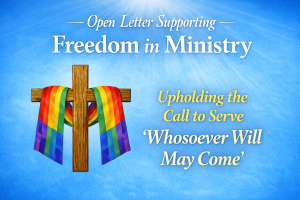
 We invite fellow Cumberland Presbyterians to sign this open letter of March 20, 2026:
We, the undersigned Cumberland Presbyterians, ministers, elders, and members, write in public support and affirmation of the right and responsibility of ministers and church sessions to carry out pastoral ministry in ways that faithfully serve the needs of their particular congregations and communities.
Since its beginnings in the second Great Awakening, the Cumberland Presbyterian Church has trusted pastors and sessions to minister with prayerful discernment and sensitivity, making decisions suited to the unique needs of their communities, valuing local discernment and contextual ministry over rigid uniformity. This spirit of trust and decentralized authority made possible historic developments such as the early inclusion of African Americans and women in ordained ministry, as well as the founding of some of the first higher education institutions to admit women.
Christian ministry is not one-size-fits-all. Every community is unique, and every pastoral situation calls for wisdom, compassion, and attentiveness to the Spirit’s leading. As a denomination that from its beginning was especially attuned to the calling of individuals and the movement of the Holy Spirit, we affirm that in contexts where churches come to know, love, and affirm their LGBTQ+ members, this should include the freedom to extend the full ministry and blessings of the church—including marriage.
We uphold the freedom of ministers and sessions to prayerfully respond with care and integrity, especially when celebrating the love, commitment, and covenant shared between two people, including members of the LGBTQ+ community. We understand that sincere Christians may differ in their discernment, yet we believe such ministry is a faithful expression of the Gospel—a Gospel that calls us not to judgment but to love, not to exclusion but to embrace.
The Cumberland Presbyterian Church has long affirmed that “God alone is Lord of the conscience” (Confession of Faith 6.02). This foundational principle empowers pastors and sessions to minister according to their prayerful discernment, theological understanding, and the particular needs of the people they serve. We discern that the Spirit-led, Gospel-centered, and contextually sensitive ministry described above is fully in keeping with God’s word and the Gospel, therefore, appropriate ministry for all ministers and sessions called to it.
We believe faithful ministry requires freedom—freedom to respond to real lives, real relationships, and real spiritual needs. Actions that force conformity on such matters, or seek to penalize or silence such ministry not only violate the conscience of pastors and congregations but contradict the inclusive, grace-filled mission of the Church. We also recognize that restricting such ministry causes real harm—to individuals, families, and congregations seeking to live faithfully in response to God’s love.
We are deeply concerned by any attempt to discipline or constrain ministers or sessions who act in good faith, according to their conscience, and in faithful fulfillment of their pastoral responsibilities. Whether through welcoming marginalized persons into the life of the church, offering pastoral care, or officiating weddings, such ministry reflects the very heart of Christ, who consistently reached toward those others would turn away. As our Confession of Faith declares, God calls the church “to embrace each person and all groups of persons within the family life of the covenant community” (6.16).
We do not ask every church or minister to think or act alike. As Cumberland Presbyterians, we have long embraced a tradition of forbearance—recognizing that faithful Christians may arrive at different convictions, particularly on matters not essential to salvation. Our unity is not rooted in complete agreement, but in our shared commitment to Jesus Christ as Lord. As our Confession of Faith affirms, “The church is one because her Head and Lord is one, Jesus Christ. Her oneness under her Lord is manifested in the one ministry of word and sacrament, not in any uniformity of covenantal expression, organization, or system of doctrine” (5.02).
The Introduction to the 1883 Confession of Faith (reprinted in the 1984 Confession) echoes this spirit, reminding us: “Nevertheless there are doctrines and forms with respect to which [persons] of good character and principles may differ; and in all these it is the duty of all private Christians and religious bodies to exercise forbearance toward one another.” In this spirit, just as some ministers and sessions may choose not to officiate same-sex marriages out of their conscience and understanding of scripture, others should be free to do so—also out of conscience, and in faithful response to the Gospel and the needs of their communities.
Therefore, we urge all governing bodies within the Cumberland Presbyterian Church, including presbyteries, disciplinary and judicial commissions, and the General Assembly, to actively safeguard the freedom of ministers and sessions to serve as they are called by God, in response to the needs of their communities, and in faithfulness to the Gospel. We further call on these bodies to reject any effort to undermine pastoral authority, conscience, or contextually sensitive ministry, and to dismiss any complaints or charges against those who have acted with pastoral integrity and in good faith in ministry with the LGBTQ+ community.
To our LGBTQ+ siblings, and to the ministers and congregations who welcome “whosoever will may come” affirming their loving, committed relationships, we say this: You are not alone. You walk in step with the God who is love, and we walk with you.
In Christ’s Peace and Love
Concerned Cumberland Presbyterians
Join us in signing this letter (Scroll down, add your name and submit to sign).
